

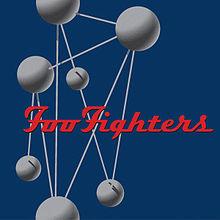
FOO FIGHTERS
THE COLOUR AND THE SHAPE
MAY 20, 1997
Initially when the first track "Doll" rolls into the listener’s ears a bit of The Beatles is channeled from 30 years earlier. The second track "Monkey Wrench" dispels any connection between the two bands as Grohl once again hits hard on the guitars while completely moving the drums.
Who would have thought that during the peak of Nirvana that they would be harboring such a powerful songwriter. Dave Grohl can stand side by side with Kurt Cobain's strong grind/scream vocals. Melodically, Grohl has the upper hand as can be heard in "Hey Johnny Park" as he takes the vocals to the lowest of the low then up the hill and back.
Most drummers are not good front men and enjoy an extended solo that brings the house down. The front man for Foo Fighters cannot be contained on the throne surrounded by layers of drums. He is like Pac-Man who gobbles up the dots and just gets stronger with every song he writes. The only thing that lacks during this play is some funk that moves more than the head-bob or a crowd bounce.
"My Poor Brain" has few lyrics which are always what I look for in strong songwriting. Yet the song makes up for it with a great combination of power chords that stab to the core of what the lyrics are trying to convey. This concept continues during "Wind Up" with expanded lyrics. It shows that there is so much potential lyrically under the surface of Grohl. It seems that at times he is condensing the song down to the core of a message and what that message might be becomes so clear.
Maybe one day Grohl will get credit for his pen to paper adventures. Until then, "Up In Arms" will be hidden from those who skip over as the beginning is less adventurous. Marcy Playground's "Sex and Candy" without the sex & candy streams through the initial opening and quickly the vocals turn on the IN YOUR FACE button. "My Hero" will push the band into the top 20 rock bands of 1997 as the lyrics and music peak this release. It exhausts the listener while the CD is only just hitting its stride, and there are still several tracks remaining that are much more than b-side or album fill-ins.
"See You" and "Enough Space" are in complete contrast to each other with the first preparing the band for a respite on stage followed by the song that will set up a more aggressive bundle of songs. Even though the rhythm guitars grind to give the Foo Fighters sound the second guitar delivers an off beat during "Enough Space" to give unpredictability to the song and shows the growth in the writing.
"February" brings the melodic heart of Foo Fighters and Grohl's rare venture into the past.
"Everlong" has a dry vocal that is neither melodic or in your face. As the song begins, Grohl leaves everything in the dust from past recordings and just gives a true accounting of rock vocals. This shows that he is more than a screaming rock singer or a melodic cry baby.
Bringing in musicians to legitimize Foo Fighters as a band will open the door for even further growth as they take to the road and become tighter. Just a little footnote, it is unclear how much input Gil Norton had as a producer and where the Foo Fighters producing was controlled by Dave Grohl. None of that matters because whatever the behind the scenes workings were, it comes down to one of the greatest rock records ever.
11/29/10

RUSTY
5/20/97