

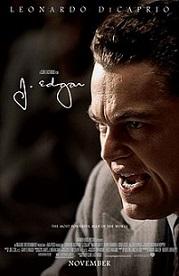
J. EDGAR
NOVEMBER 11, 2011
Never interested in history in general as a kid, the only exception was music and television. I became intrigued by the parallel lines drawn with music and any other category. Politics, civil rights, wars, even the medical field can influence the music whether it be by lyrics or musical styles. Now with any chance to see a movie that has historical content, my eyebrow raises.
This film, however, caught my attention immediately, as Clint Eastwood directs Leonardo DiCaprio (J. Edgar Hoover) about the life of J. Edgar Hoover. The dark lighting brings out the style of clothing of which was J. Edgar's demanded look for everyone in his employ. DiCaprio thrives when depicting characters long since passed in a time many decades ago. He has the ability to draw the viewers in with his eyes as he displays numerous emotional depictions. He continues to pick great films to build on a superb resume.
Clint Eastwood is able to take all he has learned from his years in front of the camera and use it at the right time on the right films he directs. Choices are what has kept Eastwood in the strong running against up and comers since he accepted the role of Joe (Man with No Name) in "A Fistful of Dollars" in 1965. The "Dollars Trilogy" that also consisted of "For a Few Dollars More" and "The Good the Bad and the Ugly" may have been less about choices and more about the offer and the money that went along with it. He never took his acting incredibly seriously but the more he observed the better he was received by audiences.
His directing, however, is a different story, as this seems to be something he was born to do. His quiet demeanor, never following in the footsteps of all the cliches concerning directors, Lights/Camera/Action is just not his approach to the craft. Simple and to the point allows the actors to become enriched with the atmosphere and everyone brings their A-Game to the projects Eastwood directs.
J. Edgar Hoover was a man of little patience for lack of common sense and unwillingness to dedicate every waking moment to his job. Thinking outside of the box was something that came naturally to Hoover, and some would say he was a visionary who instituted creative modern investigation techniques that are still used today. Many are unwilling to support new technology even if it betters the results they need to capture criminals. DNA is a result of the early practices of Hoover in his forensic laboratories. Centralizing fingerprints began due to J. Edgar's demands to have investigations conducted in a defined manner where these prints could be shared.
Ridicule is the way to keep growth from happening, and it is clear that this was used to keep J. Edgar from advancing his theories. How much of the film's story is accurate may never be known, as most of the documents that could corroborate it have long since been destroyed. Dustin Lance Black does all he can to condense so many years that incorporate so many events down to one of the longest films of 2011. Since most of what Hoover did in public and private is either not known or secured information, it may have been a difficult writing task. Black does a great job touching on so many aspects of Hoover's life.
J. Edgar had few in the way of friends but those who were part of the inner circle were completely dedicated to his every need. Black was able to brings this out less in the dialogue but more in the actions of each character. If you however, did not fit Hoover's protocol or did not see things they way he did, only time would tell how long you would continue in your role within the Bureau. The deep colors and dark lighting work perfectly in supporting this message.
Armie Hammer (Clyde Tolson) and Naomi Watts (Helen Gandy) play Hoover's most trusted confidants. Each actor brings the screen to life with their portrayals. Hammer is sweet and instantly likable while he shows the strength Clyde had early in his career with Hoover. When the surrounding staff of J. Edgar does not do as he sees fit, a penalty is assessed and few are allowed back into his fold. Clyde was given a second chance and he saw that it never happened again. Hammer was able to depict the decline in Tolson's personality while showing his learned approach to Hoover when discussing ideas.
Watts as Gandy is an amazing choice as she, like DiCaprio, picks quality scripts and this character is one of her greatest choices. She gives hers strength with endurance but only lets the audience see the smallest amount of tolerance for Hoover's domination. She seems to be the one person in his life that, reflective of his mother, can turn him from doing exactly what he wants.
Judith Dench (Anna Marie) plays Hoover's mother, a sly devious dominating personality throughout his life. She controls is personal life with no physical abuse but the mental power held in her words controls J. Edgar for the duration of her life. On screen, Dench and DiCaprio have an uncanny chemistry that could possibly hold the true relationship idiosyncrasies. J. Edgar Hoover's mother in many ways was who he was due to her direct influence on his personality. His weakness at home was turned to power and control at his job.
Props to everyone involved in the creation of this film because as much as Hoover kept files on everyone around him, few kept records of his life. Those closest to him rarely spoke in public of the FBI's first director, J. Edgar Hoover.
The length on the movie was necessary as there was constant dialogue with the writer trying to incorporate as much of the events that happened whether real or in the mind of Hoover. Due to this, Eastwood was not tempted to pan long landscapes to fill time in the movie. The more scenery, the less strength of the script, and directors are forced to cover this up with a secondary film crew who must scout landscapes and film them for the movie's filler.
Our viewing was marred by the reel literally beginning to disintegrate halfway through the movie. Regal Cinemas on Elmwood in Buffalo, New York did little to appease an almost sold-out viewing audience. Someone came into the theater, spoke so soft most of us in the back had to look to people in the front to relay the information. We were offered a chance to come back the next day. The problem with that idea is we had already sat through more than half of the movie. The other option was to wait it out while they repaired the problem. I chose to wait for the completion of the repair, hoping it would start as close to where the film went array. After several starts with no sound or a horizontal split screen, it began to roll with both now intact. The patrons began to shout as the focus was at times so off DiCaprio looked no different than Watts.
It would have been nice for those of us willing to wait to be offered a small drink and popcorn. We had to watch the rest of the film with the lights on because no matter how loud we shouted they just were not going to turn them off. Thankfully, the film was good enough to allow us to let this failure pass.

RUSTY
11/11/11