

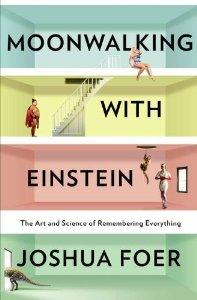
MOONWALKING WITH EINSTEIN:
THE ART AND SCIENCE OF REMEMBERING EVERYTHING
JOSHUA FOER
FEBRUARY 28 2012
In the U.S. Memory Championship, “mental athletes” participate in four events – they are given 15 minutes to memorize 117 color photos of different people with their first and last names, (spelling counts!) 5 minutes to memorize 25 rows of 20 randomly generated numbers, 15 minutes to memorize a previously unpublished poem, and are timed on how quickly they can memorize the order of a deck of 52 playing cards.
When Joshua Foer, a science journalist, covered this event, he was taken aback by the claims of the participants that their memories were “nothing special” – that they had just learned special memorization techniques. Intrigued, Foer decided to research the event and eventually participate.
This book follows Foer’s journey from a journalist to the United States memory champion. He meets many interesting people who help him learn the techniques used by world champion memory athletes. He also travels around the world to interview anomalies of modern neuroscience and dedicates a chapter to each. “The Man Who Remembered Too Much” had a flawless memory of conversations and his personal surroundings, but was unable to think in abstract terms and only able to comprehend anything literally. “The Most Forgetful Man In The World” who had part of his brain eaten away by a virus was unable to make new memories, and was mentally living in a time when Eisenhower was president. However, he was blissfully unaware of his problem, as he would forget somebody telling him about it as soon as they were finished with the conversation.
Foer learns about the PAO system, which converts numbers into unforgettable images (hence the title of the book), and about the “memory palace” – where memories are stored in the rooms of imaginary structures.
An especially interesting theme in this book is how Americans are so much more inferior to those of other countries in matters of memorization. The international memorization records put those of the United States to shame, and this reflects a huge flaw in the education system. The bottom line is that in America, we are taught WHAT to memorize, not HOW to memorize. Memory used to be an art form, and Foer discusses the transition of “internalized” memory to “externalized” memory with the modernization of products that do our memorizing for us. Our education system compared to that of other countries is summed up in the quote: “It’s the difference between teaching a kid multiplication and giving him a calculator.”
This book is an excellent read, and definitely opens the reader’s eyes. I highly recommend reading it.

rmk
2/28/12